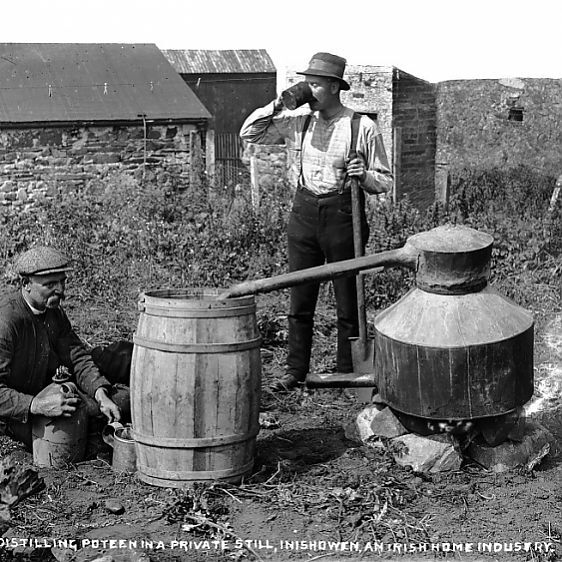
Many people have asked the question about Irish Poitin. Where did it come from or what’s the story? Well, to be more specific, the word is generally, shush, it’s illegal. To be more open about it, the story goes back a long way in Irish Tradition. The same I suppose can be said about Moonshine in America, or did the Irish from the famine boats show how it was actually distilled? We can leave that one to the historians for now. Let’s go back a bit to when the distillation of spirits in Ireland needed to be authorised and was duly introduced by the parliament at Drogheda in 1556 and necessitated a license under the great seal. This was an official seal held in Dublin Castle until 1922
So in 1831 The Illicit Distillation (Ireland) Act, gave wide powers to the excise officers to eradicate the poteen trade in Ireland. Hence the hush-hush scenario because under Section 18 of this Act, the officers upon finding such “still” equipment, could forcibly enter the property without a warrant and use any evidence found to strengthen their defense if any lawsuit was brought against them. Unfair? Well to make matters worse, any penalties imposed would in the first instance be paid for expenses. The remainder would then be one part to the King and the rest to be divided amongst the officers that discovered it or to anyone that provided information that led to the discovery.
In consultation with producers and stakeholders in 2015, the Irish Government adopted the Geographical Indication technical file for poitin, pointing out the production methods that must be used for a spirit to be called.. Irish Poitin. Items that were discussed included allowable base materials, distillation method, use of flavourings/infusions, and limited storage of the product in casks.
To some, the idea of legal poitin has been looked upon as a contradiction, with one writer stating, “If you see a product labelled “poitin” in an airport or at a bar, it’s simply a white duty-paid Irish schnapps version. By definition, poitin is illegal and can not be sold.”
The distilling of the poitin in the old ways, was from a malted barley base for the mash, the same as single malt whiskey or pure pot stilled whiskey distilled in Ireland. The word poitin stems from the Irish gaelic word “pota” meaning a pot which refers to the small copper pot still used by poitin distillers.
In more recent times, some distillers deviated from using malted barley as a base for the mash due to the cost and availability, instead switching to using treacle, corn, and potatoes. Because of this switch, it is said that it led to the deteriorating quality and character of poitin in the late 20th century. One way or another, Poitin has been with us for generations and will “still”, if the terms allow, be around for a while longer. Shhhhhhh!
My new book ‘The Curse Of Emigration’ is now available to buy from my website – www.briankermode.com

 Author Brian Kermode