
In the annals of American history, countless figures have emerged from the rugged landscapes of the “Wild West”, capturing the imagination of a nation in their tales of adventure and bravery. Names such as Buffalo Bill, Wild Bill Hickok, General Custer, Sitting Bull, Calamity Jane and among them and a friend, was a native of Carndonagh in county Donegal. His name was Captain Jack Crawford, and he stands out as a truly unique character—an individual who not only roamed the untamed frontiers as a scout but who also wielded the power of words to immortalise his experiences. Captain Jack Crawford, became known as the “Poet Scout”. He weaved together a captivating tapestry of the “Wild West” through his verses, leaving an indelible mark on both literature and the legacy of the American West.
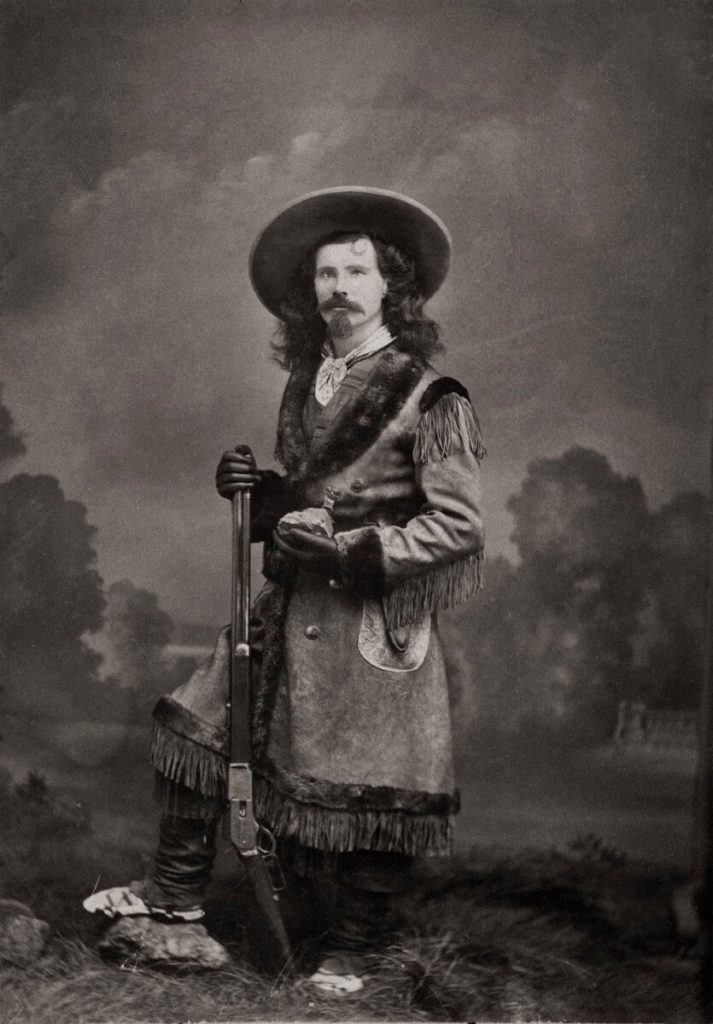
The Early Days:
Being a descendent of the “Braveheart”, William Wallace, his parents were forced to flee Scotland for making revolutionary speeches and he was born John Wallace Crawford in Carndonagh, on March 18, 1847. At the height of the Irish Famine, Captain Jack Crawford at age fourteen, emigrated to the United States from Ireland, joining other members of his family who had preceded him to Minersville, Pennsylvania, the heart of the nation’s anthracite coal region. He went to work in the mines until he reached seventeen and being inspired by the tales of the West, young Crawford yearned for adventure and eventually found his calling in the military.
Life as a Scout:
He joined the Forty-eight Pennsylvania Regiment volunteers during the American Civil War. He was wounded twice and while convalescing from the first wound in a Philadelphia hospital, young Crawford learned to read and write under the tutelage of a Sister of Charity. After the war, In 1875, Jack headed west on the “Black Hills Gold Rush”. In 1876, Custer City miners organised a 125-man militia known as the “Black Hills Rangers”. Jack was appointed as chief of scouts, a troubleshooting unit of about twelve experienced fighting men, to look for Indian signs and escort emigrants through dangerous canyons where Indians often waited in ambush. Here he was awarded the title “Captain Jack” in charge of his men.
The Power of Words:
During his time as a scout, Captain Jack Crawford narrowly missed out on being killed at the battle of the “Little Big Horn” alongside his friend “General Custer”. He discovered the solace and power of poetry as a means to express his thoughts and experiences. His verses captured the essence of the West, blending vivid descriptions of its landscapes with poignant emotions and tales of heroism. Crawford’s poetry resonated with readers, transporting them to a world where cowboys roamed free and the spirit of adventure filled the air.
Rising Fame and Legacy:
As his reputation as the “Poet Scout” grew, Captain Jack Crawford’s poems became highly sought after, published in newspapers and magazines across the country. His fame reached its pinnacle when he was appointed as the “Poet Laureate of Buffalo Bill’s Wild West Show,” a testament to his skill in capturing the essence of the “Wild West”.
Crawford’s verses immortalised legendary figures such as Wild Bill Hickok and Buffalo Bill Cody, recounting their exploits in a way that made them larger than life. Through his poetry, Captain Jack Crawford brought the spirit of the “Wild West” to audiences far and wide, preserving its legends and inspiring future generations.
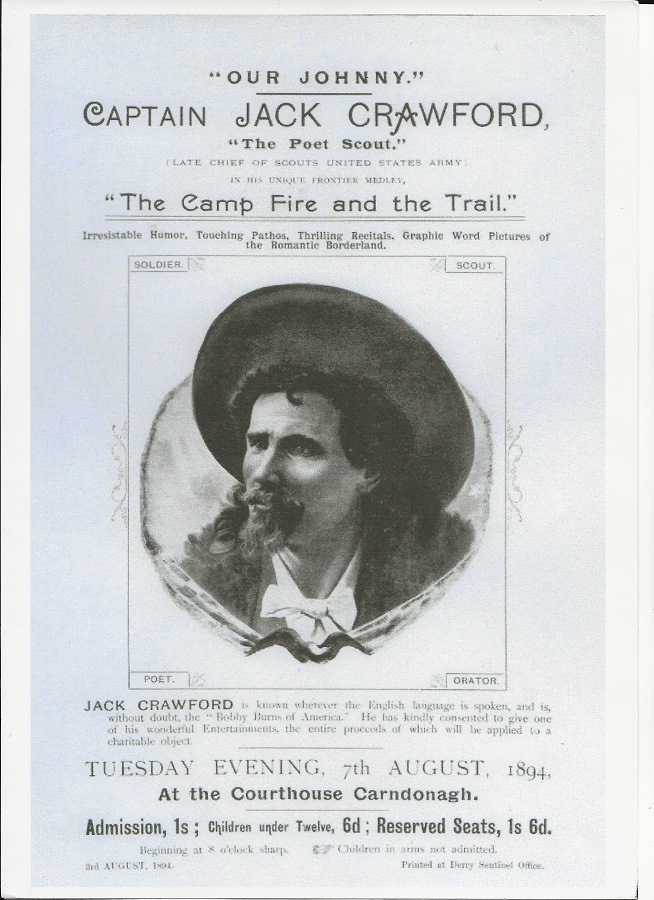
Conclusion:
Captain Jack Crawford, the Poet Scout, left an enduring legacy through his evocative poetry that captured the essence of the Wild West. Through his verses, he painted a vivid picture of a time and place filled with adventure, courage, and the untamed spirit of the American frontier. Crawford’s ability to blend his experiences as a scout with his poetic talents made him a unique figure in American history, ensuring that the stories of the “Wild West” would be forever etched in the minds of readers and poetry enthusiasts alike. He even became an extremely popular stage performer and the thoughts of his homeland, Carndonagh in Donegal, saw him bring his ‘Frontier Show’ to Carndonagh on the 7th August 1894 to wild acclaim. Captain Jack spent the next two years in the Klondike, fruitlessly searching for gold, and for the next decade he travelled throughout the country staging entertainments. He moved back to New York and died on 27th February 1917. The “Poet Scout” remains an emblem of the indomitable spirit that defined the American West, reminding us of the power of words to transcend time and preserve the legends of a bygone era.
Images: Donegal Daily.
 Author Brian Kermode
One response to “Captain Jack Crawford: The “Poet Scout” who immortalised the “Wild West””
Morning…. Several years ago I wrote a book. “Stories the Canyon Keeps”. It details my husband’s family, the Bass and Lauzon families, and their lives at the Grand Canyon. William Wallace Bass arrived there from the East in 1884 and established a camp of the very edge of the Great Abyss. He would host the.rich and famous, Zane Grey, John Muir, Thomas Moran just to name a few. Oh yes, and my personal favorite, a friend of his for over 40 years, Captain Jack Crawford the Poet Scout. Check out our website, grandcanyonproject.com. During my research for my book I came across photos of the two as well as correspondence. Captain Jack was, hands down, one of the most interesting characters I have ever come across. If you would like to know more I would love to chat. My email is… storiesthecanyonkeeps@outlook.
Cheers….Debbie Probst-Gipson
LikeLike