
When we think of pirates, the names of Blackbeard and Captain Kidd often come to mind. But history’s oceans are vast, and their waves have carried tales of formidable women pirates as well. Among them, Grace O’Malley, known in Irish as Gráinne Ní Mháille, ( pronounced in Irish as: “Grawn-ya Nee Mallya” ) stands out as a figure of unparalleled audacity and resilience. She was born into a time of political upheaval and clan warfare and Grace O’Malley carved out her legacy on the rugged coasts of 16th-century Ireland. Her story is one of rebellion, leadership, and tenacity against the forces of the English crown and traditional gender roles.
Early Life and Rise to Power
Grace O’Malley was born around 1530 to the chieftain of the O’Malley clan, one of the seafaring families of County Mayo. Her father, Eoghan Dubhdara Ó Máille, ( Owen-Duve Dara-O-Mallya ) commanded a fleet of ships, and it was on these ships that young Grace learned the art of sailing and seafaring. From an early age, she showed an extraordinary aptitude for the sea, earning the nickname “Gráinne Mhaol” ( Grawnya-M’wail meaning ‘Bald Grace’) after cutting her hair short to join her father’s expeditions- defying the gender norms of her time.
Upon her father’s death, Grace took over the family’s fleet and lands, demonstrating exceptional leadership and strategic prowess. Her marriage in 1546 to Dónal an Chogaidh Ó Flaithbheartaigh, who was another powerful chieftain, further strengthened her position. She had three children: Eóghan (Owen) the eldest, who was known to be kind and forgiving, but was tricked by Sir Richard Bingham. Eóghan was murdered as a result, and Bingham and his troops took over his castle. Méadhbh (Maeve) said to be very much like her mother, married Richard “The Devils Hook” Bourke. They had several children together and lived a happy life. The youngest of Grace’s children was Murchadh (Murrough). Murchadh was said to take after his father, because he enjoyed warfare. He often beat his sister, Maeve, and refused to listen to his mother, Grace. Many sources report that he betrayed his family, and joined forces with Sir Richard Bingham after the murder of Eóghan . When Grace heard of this, she swore she would never speak to Murchadh ever again for the rest of her life, although she would often insult him if she seen him. After the death of Graces’s husband, she returned to the O’Malley territory, consolidating her power and expanding her influence over the seas.
The Pirate Queen
Grace O’Malley’s reign as the “Pirate Queen” is marked by her control over the waters of Clew Bay, off the West coast of Ireland in County Mayo, where she commanded a fleet of ships and engaged in both legitimate trade and piracy. She imposed taxes on ships that passed through her waters, demanding payment for safe passage—a practice that was both a source of income and a demonstration of her authority.
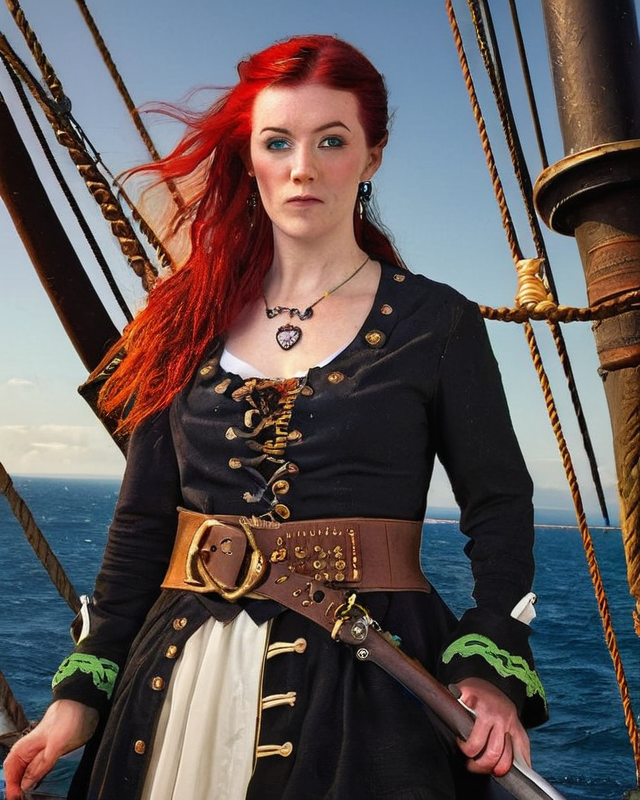
Her exploits became legendary. Grace’s fleet would often raid coastal settlements and attack merchant ships, making her a formidable force in the region. She maintained her power through a combination of naval supremacy, strategic alliances, and sheer force of will. Her leadership was so effective that even the formidable English navy found it challenging to curb her influence.
Defiance Against the English Crown
Grace’s conflict with the English crown reached its peak during the rule of Queen Elizabeth I. The English authorities, eager to assert control over Ireland, viewed Grace’s independent power as a significant threat. In response, they captured her and held her prisoner in Dublin Castle. Displaying her indomitable spirit, Grace managed to secure her release through negotiations and a promise to aid the English against their enemies, although she continued her rebellious activities.
In 1593, Grace O’Malley boldly sought an audience with Queen Elizabeth I in Greenwich. Their meeting is shrouded in legend, with accounts suggesting that Grace refused to bow before Elizabeth, seeing her as an equal rather than a superior. The two formidable women negotiated terms that allowed Grace to maintain her lands and some autonomy in return for her loyalty to the crown.
Legacy
Grace O’Malley lived a long life, passing away around 1603. Her legacy as the “Pirate Queen of Ireland” endures, celebrated in songs, folklore, and historical accounts. She symbolises defiance against oppression and the struggle for autonomy in a turbulent era. Her life story, marked by bravery, resilience, and strategic acumen, continues to inspire, illustrating that even in the face of overwhelming odds, one can chart their own course and leave an indelible mark on history.
Today, Grace O’Malley is remembered not just as a pirate, but as a trailblazer who navigated the treacherous waters of 16th-century politics and patriarchy with unparalleled skill and determination. Her story reminds us that true leadership and courage know no bounds, whether on land or at sea.
Written by Author Brian Kermode
*History source: Wikipedia*
 Author Brian Kermode